




How to Choose a Scented Candle That Actually Works in an Indian Home
You light the candle. You wait. Five minutes later, you lean in close and smell something. Yes, it is there. But nothing has changed in the room.
This is the most common experience Indian candle buyers have, and it is not their fault. The candle they bought was almost certainly designed for a different home in a different climate. The specs that make a candle perform in a sealed, insulated Western apartment do not translate to an Indian living room with open layouts, competing kitchen smells, and humidity that changes by the season.
Choosing a scented candle for an Indian home is a different problem than most buyers realise. This guide explains exactly what to look for: the two technical variables that determine whether a candle will fill a room, the first burn rule that most people skip and regret, and a room-by-room sizing guide based on how Indian homes are actually laid out.
Why Most Scented Candles Fail in Indian Homes
The numbers behind candle disappointment in India are striking. When you look at the coded complaints from Indian candle buyers across platforms, weak or absent scent throw accounts for 42% of all negative feedback. Not broken glass, not wrong colour, not late delivery. The candle just does not smell like anything.
The reason is structural.
Most imported candles and many domestic brands formulate for closed, carpeted, 300 to 400 square foot Western rooms where air does not circulate much. The fragrance concentration needed to fill that kind of space is significantly lower than what is required in a standard Indian apartment.
Indian homes present several variables that work against low-load candles:
Open floor plans and connected spaces. Many Indian apartments have a living room that flows into a dining area and sometimes a kitchen corridor. The scent does not stay in one defined zone. It diffuses into a larger combined volume. A candle formulated for a 350 square foot sealed room may be filling an effective space nearly twice that size.
Humidity. Both high humidity in coastal cities and the dry heat of northern Indian summers affect how fragrance molecules travel and how quickly they dissipate. High humidity can suppress scent diffusion. Dry heat can cause fragrance to burn off faster near the flame than it spreads into the room.
Competing smells. This is the variable no imported brand has ever formally addressed. If incense was lit earlier that morning, if the kitchen corridor leads straight into the living room, if someone used a strong floor cleaner, a candle with a modest fragrance load does not have the throw capacity to establish itself over those background scents. The room's olfactory baseline is already occupied.
Air conditioning. An AC unit running in a closed bedroom might seem like ideal conditions for a candle, but the air circulation pattern matters. Cold air pooling low while warmer candle-scented air rises can create a stratified environment where the fragrance does not distribute evenly across the room.
None of this means candles cannot work in Indian homes. It means the candle needs to be built differently, specifically with a higher fragrance load and a wax that delivers that fragrance consistently. Most candles on the Indian market are not built this way.
The Two Variables That Decide Whether a Candle Will Work
Once you understand why candles fail in Indian conditions, the buying decision becomes much simpler. There are two numbers that matter above everything else.
1. Fragrance Load
Fragrance load is the percentage of fragrance oil relative to the total wax weight. A 200 gram candle with 8% fragrance load contains 16 grams of fragrance. A 200 gram candle with 4% fragrance load contains 8 grams.
That gap sounds small until you light both candles in the same room.
Most Indian market candles sit between 6% and 9% fragrance load. Budget and mass-market candles often sit below 6%. At that concentration, the candle may smell strong when you hold it close, what the industry calls "cold throw." But once lit, the hot throw (how much the room actually fills) is underwhelming.
The standard for genuine room-filling performance in a typical Indian apartment is a fragrance load of 8% at minimum. For larger or more open spaces, 10% to 11% makes a meaningful difference.
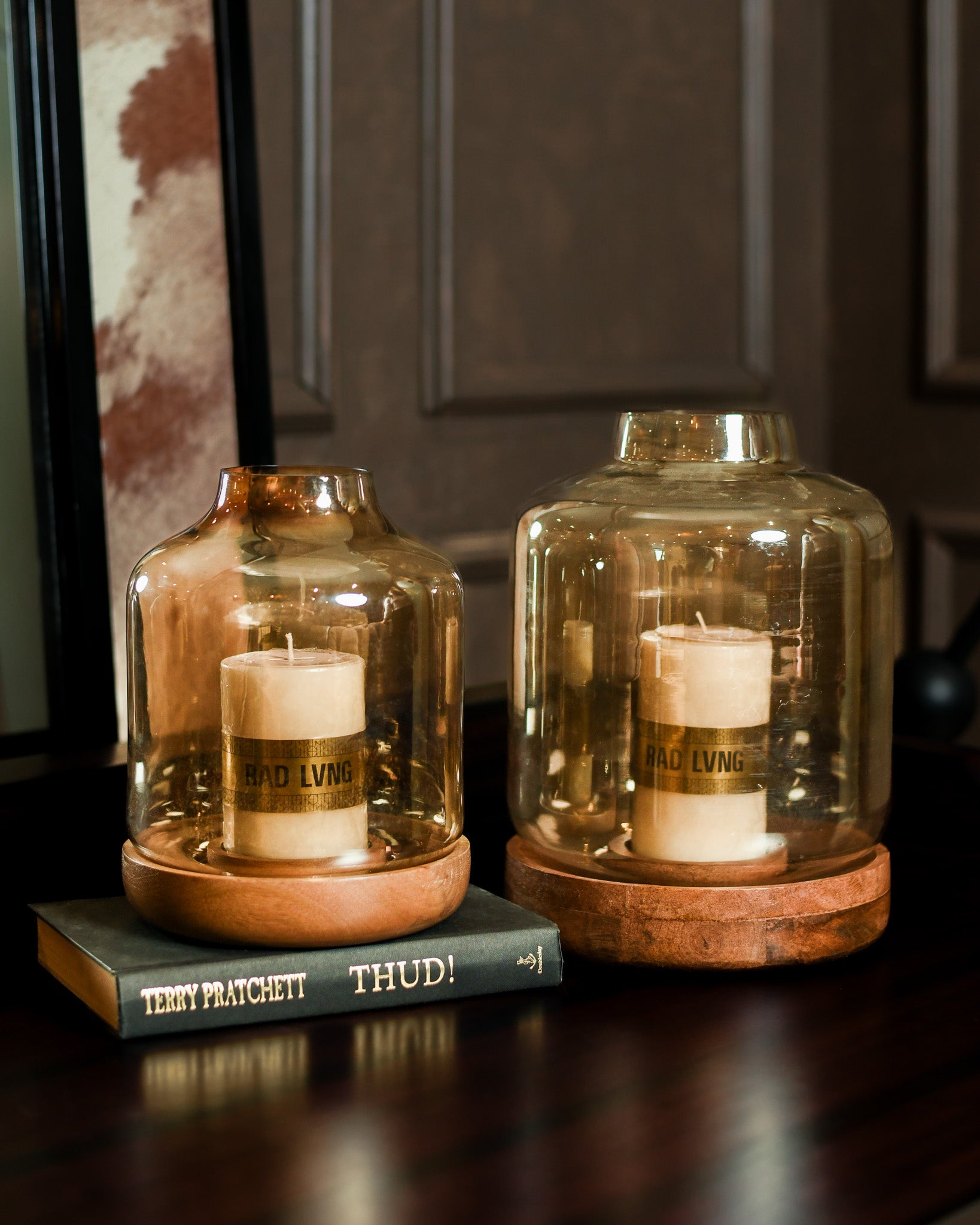
RAD LVNG candles carry about 1.5x the fragrance load of standard market candles, putting them at the top of the Indian market and consistent with global fragrance standards. This is the reason regular buyers report that the fragrance is noticeable from across the room rather than only near the candle.
When you are buying a candle and the fragrance load is not listed anywhere on the packaging or product page, treat that as information. Brands that know their fragrance concentration is a selling point tell you.
2. Cure Time
This is the variable almost no buyer knows to ask about, and it is responsible for a large portion of "the candle smells strong when I open it but fades quickly" complaints.
When a candle is poured, the fragrance oil needs time to properly bind with the wax molecules. This process is called curing. A candle poured and shipped within 24 to 48 hours has not cured. The fragrance sits loosely in the wax rather than being fully integrated into it.
The result: the candle smells excellent when you open the packaging. The cold throw from the unlit wax is strong. Then you light it, and the scent fades within the first hour or deteriorates quickly over subsequent burns. The fragrance was not bonded well enough to release slowly and consistently as the wax pool develops.
A properly cured candle takes between 4 and 7 days after pouring before it is ready to burn. During that time, the fragrance molecules fully integrate into the wax structure. When you then light the candle, the fragrance releases gradually and consistently from the first burn through to the last.
RAD LVNG candles cure for 4 to 7 days before shipping. This is not a speed-to-market decision. It is what separates consistent scent throw across the candle's entire life from an impressive opening that fades.
Ask yourself this when shopping: does the brand say anything about cure time? If they do, they understand candle chemistry. If the product page has ten adjectives and no technical detail, the cure process may have been skipped.
A Room-by-Room Guide to Candle Sizes for Indian Homes
Candle sizing guidance in India tends to be either absent or vague. "Perfect for any room" is not useful information. Here is a practical framework based on how Indian homes are typically laid out.
Washrooms and Powder Rooms
The smallest, most enclosed space in most Indian homes, and genuinely the easiest room to fragrance with a candle.
A 65 to 100 gram candle is sufficient for a standard Indian washroom. The enclosed space and limited air volume mean even a modest fragrance load will be effective. A 220 gram candle in a small washroom can actually be overwhelming. The concentration becomes too intense in a confined space.
Keep the candle on a stable, heat-safe surface away from textiles. Washrooms often have exhaust fans, and when the fan is on the scent dissipates faster than usual. A lighter or longer burn works better than a heavy short one in these conditions.
Burn time reference: a 100 gram RAD LVNG candle gives up to 18 hours of burn time. For a washroom used 2 to 3 times a week with 30 to 45 minute burns, this is around 2 months of use per candle.
Bedrooms
A standard Indian bedroom, typically between 100 and 180 square feet, is the sweet spot for a single-wick 220 gram candle.
At this size, the fragrance load and wax volume are well matched to the room. The candle can fill the space within 20 to 30 minutes of lighting without becoming oppressive. If the room is on the larger end or has a door that is often left open to a corridor, a 350 gram candle or a larger 220 gram with higher fragrance load will serve better.
Do not burn a candle in a bedroom while sleeping. The instruction sounds obvious but it is worth stating: an unattended candle in an enclosed room is a fire risk, and the fragrance concentration of a candle burning for 7 to 8 hours in a sealed room is not comfortable to breathe in that volume. The correct use is to light the candle before you want the fragrance, let it fill the room, then extinguish before you sleep. The scent will linger for 30 to 60 minutes after the flame is out.
Burn time reference: a 220 gram RAD LVNG candle gives up to 36 hours of burn time.
Living Rooms and Open-Plan Spaces
This is where most candle disappointments happen in Indian homes, and it is almost entirely a sizing problem.
A single-wick 220 gram candle in a 400 square foot living room that opens to a dining area will produce noticeably less scent impact than it would in a closed bedroom. The combined volume is simply too large for a single smaller candle to fill consistently.
For living rooms and open-plan spaces, the correct approach is either a larger single candle or a multi-wick candle. A 350 gram single-wick candle delivers up to 45 hours of burn time and a fragrance load designed for a larger space. A 250 gram 3-wick candle's multiple wicks create a wider and more even wax pool, which means more surface area releasing fragrance simultaneously.
The 3-wick format is often the better choice for Indian living rooms precisely because of the open-plan issue. Three wicks burning together push the fragrance outward from a wider base, which is more effective in open or connected spaces than a single wax pool at the centre of a larger jar.
If your living room has high ceilings, a common feature in older Indian apartments and newer open-concept builds, add one size up to compensate. Fragrance rises. High ceilings mean more air volume to fill before the scent reaches nose height.
Dining Tables and Hosting Settings
The dining table is one of the most effective spots to place a scented candle, and also the most commonly mismanaged.
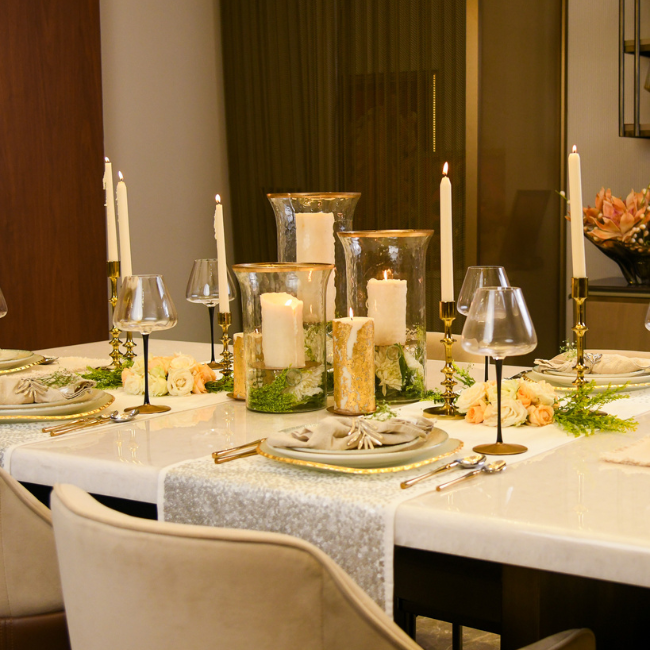
At a dining table, the candle is close to people. This means the fragrance does not need to fill the whole room. It needs to be present at face height for everyone seated. A well-chosen 220 gram candle placed centrally works well here.
One important note for hosting: avoid extremely heavy or spiced fragrance profiles at the dining table if food is being served. Fragrance that competes with food smell creates a sensory conflict that most people find unpleasant even if they cannot name why. Lighter florals, citrus-forward, or clean woody scents tend to work better on a dining table than deep oud or heavy amber.
Large Format and Landmark Placement
RAD LVNG makes large format candles in 1.5 kilogram, 3.5 kilogram, and 7.5 kilogram formats for large rooms, events, and statement placement. These are not everyday living room candles. They are for foyers of larger homes, event venues, or as design objects that happen to also fragrance the space substantially.
If you are buying for a large open-plan home, a two-floor villa, or a large office space, these are worth exploring. For a standard urban apartment, they are more visual statement than practical fragrance solution.
The First Burn Rule (and Why Skipping It Kills the Candle)
This is the single most important piece of candle care information and the one most buyers ignore. Skipping it does not just reduce your first burn. It damages every burn after it.
The rule: on your very first light, let the candle burn until the entire top surface of the wax has melted to the edge of the jar. Do not blow it out after 30 minutes because you are done with the room. Do not blow it out after an hour because the flame looks fine. Wait until the wax pool reaches the glass on all sides.
The reason this matters is wax memory.
Candle wax has a property called melt memory. On the first burn, the wax creates a melt pool, the liquid wax around the flame. If you extinguish the candle before that pool has reached the edges, the wax solidifies with a ring around the outside that has never melted. On every subsequent burn, the wax only melts as far as it melted the first time. The flame burns down through a tunnel in the centre of the jar, surrounded by solid wax it will never reach again.
This is called tunnelling, and once it starts it cannot be undone. The candle burns faster because the flame has no wide pool to draw from. The fragrance throw decreases because the surface area releasing scent is dramatically smaller. You lose probably 30 to 40 percent of your candle's burn life and most of its scent output, simply because the first burn was cut short.
For a 220 gram candle, the first burn to full pool typically takes 2.5 to 3 hours. For a 350 gram candle or a 3-wick, plan for 3.5 to 4 hours. Do not light a new candle unless you have that time available.
Two additional care notes that protect your candle beyond the first burn:
Trim the wick. Before every burn after the first, trim the wick to approximately 5 millimetres. A long wick creates a larger, hotter flame that consumes the wax too quickly, produces more soot, and can cause uneven burning. Nail scissors or a proper wick trimmer both work. This one habit extends burn time meaningfully.
Do not burn beyond 4 hours in a single session. After 4 hours, the wick has absorbed enough heat that the flame can start to behave unpredictably and the fragrance oils near the surface can burn off rather than evaporate gradually. Extinguish at 4 hours, let the wax resolidify completely, then relight when you want fragrance again.
What to Look for When You Buy
Most candle product pages in India tell you the scent name, the weight, and a few adjectives. Very few tell you the things that actually determine whether the candle will work.
Here is the checklist that matters when buying a scented candle for an Indian home:
Fragrance load, stated clearly. The brand should tell you the percentage. Anything below 8% is unlikely to fill a standard Indian room. A brand that does not state its fragrance load either does not know it or does not want you to know it.
Wax type, with specifics. Soy-based and soy-blend waxes are the standard for clean burn at the premium end of the market. The specific reason matters: soy wax has a lower melting point, which creates a wider melt pool at lower temperatures. This matters for scent throw in Indian homes where you may not want to burn the candle for 4 hours to get the full pool. Certified natural soy wax is known for clean burn and strong fragrance integration. Look for wax type stated, not implied.
Cotton wicks. Cotton wicks burn more cleanly than zinc-core or lead-core wicks, produce less soot, and self-trim more naturally. Most reputable candle brands use cotton wicks, but it is worth confirming.
Cure time mentioned or implied. If the brand describes its production process and mentions curing, that is a positive signal. If the product page says nothing about how the candle is made, the technical care that goes into scent performance may not have been taken.
Room-size guidance. A brand that understands how its product actually performs in real homes will give you sizing guidance. Vague "suitable for all spaces" language is the equivalent of a fragrance load that is not listed. The brand either does not know or is avoiding the question.
India-specific formulation. This is a newer differentiator but a meaningful one. Some Indian candle brands now explicitly test their candles for Indian climate conditions: humidity, heat, and the open-plan issues described earlier. A candle tested in an Indian home performs differently from a candle formulated for European or American conditions and sold into the Indian market.
RAD LVNG candles are built around these exact specifications: about 1.5x the fragrance load of standard market candles, imported certified natural soy wax, cotton wicks, and a 4 to 7 day cure before shipping. The candles across all formats, from 100 gram petite jars through to the 250 gram 3-wick, are designed around Indian room conditions rather than retrofitted from a Western standard.
For anyone who has bought candles at any price point and been disappointed by weak scent, the issue is almost always one of the variables covered in this guide: fragrance load too low, cure time skipped, candle too small for the space, or the first burn cut short. Fixing any one of these makes a noticeable difference. Fixing all of them produces a candle that actually changes the atmosphere of the room.
You can shop scented candles across all sizes and formats, or read the candle care guide for the complete care ritual that extends your candle's life and keeps the scent consistent from the first burn to the last.
Frequently Asked Questions
Why does my scented candle smell great in the store but nothing at home?
Retail stores are enclosed, relatively small, and often stacked with candles, many of them burning simultaneously. The ambient scent you smell in a candle store is not the output of a single candle. At home, one candle has to do all the work. If the fragrance load is below 8% and the room is open-plan or larger than 200 square feet, the scent will not reach across the room. The store experience sets an expectation the candle cannot meet alone.
What is the right candle size for a bedroom in an Indian apartment?
For most standard Indian bedrooms, a 220 gram single-wick candle is the right starting point. If the bedroom is on the larger side or the door is usually left open to a corridor, move to a 350 gram candle. The 220 gram size, with about 1.5x the fragrance load of standard market candles, will fill a typical closed bedroom within 20 to 30 minutes of lighting.
Do 3-wick candles actually make a difference in larger Indian rooms?
Yes, for a specific reason. Multiple wicks create a wider melt pool from a larger combined surface area. In open-plan Indian living rooms where scent needs to travel into connected spaces, a 3-wick candle distributes fragrance more effectively than a single-wick candle of similar weight. The 250 gram 3-wick format is designed for this use case.
How do I know if my candle is tunnelling?
After the first burn, look at the top of the candle. If you see a ring of solid wax around the edges with a small central pool, tunnelling has started. The melt pool did not reach the edges on the first burn. Unfortunately, once tunnelling is established it is very difficult to reverse. The best prevention is the first burn rule: burn until the pool reaches all edges before extinguishing.
Is soy wax actually better for Indian homes?
Soy wax has two meaningful advantages for Indian conditions: it burns at a lower temperature, which creates a wider melt pool relative to the flame heat, important for scent throw in Indian room conditions. It also produces significantly less soot than paraffin wax, which matters in Indian homes where surfaces and walls are close to the candle placement. Neither of these is a health claim. They are performance properties. The fragrance load and cure time matter more than wax type alone for scent throw, but soy wax supports both.
Why does my candle stop smelling after the first hour?
This is almost always a cure time issue. When fragrance oil is not fully bonded to the wax before shipping, the fragrance releases quickly from the surface layer during the first burn and then fades as the deeper wax, with its looser fragrance binding, begins to melt. A properly cured candle releases fragrance gradually and consistently because the fragrance is integrated throughout the wax structure, not sitting loosely near the top.
Can I use a large candle in a small space?
A larger candle in a genuinely small space, such as a washroom or a small study, can produce an overwhelming concentration of fragrance. The rule is: match the candle to the room. A 65 to 100 gram candle for a washroom, a 220 gram for a bedroom, a 350 gram or 3-wick for a living room or open-plan space. Going significantly larger than the room needs wastes the candle and makes the fragrance uncomfortable to be around.
How long will a 220 gram candle last?
A 220 gram RAD LVNG candle gives up to 36 hours of burn time when used correctly, meaning the first burn goes to full pool edge, subsequent burns are 1 to 4 hours, and the wick is trimmed between burns. Poor burn habits can reduce this by 30% or more through tunnelling and wick issues.
Is it safe to burn a scented candle in a room with an air conditioner running?
Yes, with two caveats. Make sure the candle flame is not directly in the path of the AC airflow. A strong draft can cause the flame to flicker, which produces uneven burning and more soot. And do not burn a candle in a completely sealed room for extended periods. The CO2 output of a candle burning in a well-ventilated room is negligible, but in a small, completely sealed, unventilated space for several hours, air quality can be affected. Standard practice: keep the space ventilated, do not burn for more than 4 hours at a stretch.
What is the best way to extinguish a candle without producing smoke?
Use a candle snuffer rather than blowing the flame out. Blowing causes the wick to continue smouldering for 10 to 20 seconds, which produces a visible smoke trail and scent that can overpower the residual fragrance. A snuffer starves the flame of oxygen and stops it immediately. If you do not have a snuffer, dip the wick into the wax pool using a wick dipper or the tip of a non-flammable tool, then straighten it. This extinguishes the flame cleanly and coats the wick in wax, which makes the next light easier.


