




One Home, One Scent: How to Find Your Signature Home Fragrance
A signature home fragrance is one scent identity carried across your whole home, instead of a different random scent in every room. You find it by choosing a single fragrance collection you are genuinely drawn to, then placing it in every format your home needs: a candle in the living room, a reed diffuser at the entryway, mood sticks for the evening, a fragrance tablet in the wardrobe. The scent changes form room to room. The identity stays the same. That coherence is what makes a home smell like itself.
This is the difference between a home that smells nice and a home that smells like somewhere. Most people collect fragrance the way they collect mugs: one here, one gifted, one bought on a whim. The bedroom smells of one thing, the bathroom of another, the living room of nothing unless something is lit. Each spot is fine on its own. None of it adds up to a feeling. A guest cannot tell you what your home smells of, because your home does not smell of one thing.
A signature scent fixes that, and RAD LVNG is built for exactly this move. We run 12 fragrance collections, and every collection spans every format: candle, reed diffuser, mood stick, and fragrance tablet, all in the same scent world. So you can pick one collection, say Way Back Home with its saffron, jasmine, and amber, and let it run through the entire house in different forms. The reason this is hard to do with most brands, and natural with ours, is the rest of this guide. We will cover how to find your scent direction, how to carry one collection across formats, how to control strength so it never overwhelms, and how to test-drive a collection before you commit the whole home to it.
What is a signature home fragrance, and why does one scent beat many?
A signature home fragrance is a single, recognisable scent identity that runs through your entire home, the way a luxury hotel smells like itself in the lobby, the lift, the corridor, and the room. It is not one product. It is one scent direction, expressed in whatever format each space needs, so the home reads as a single coherent world rather than a collection of unrelated smells.
The reason one scent beats many comes down to how memory works. The brain does not file away the bergamot in your hallway and the vanilla in your bedroom as separate facts. It files an overall impression: this home has a character, or this home does not. Coherence is what registers as intentional. A different scent in every room reads, at best, as pleasant and, at worst, as a clash you stop noticing only because you live inside it.
This is the same principle behind why certain hotels are unforgettable and certain people leave a room still smelling of them an hour later. They are not wearing five fragrances. They are wearing one, consistently, until it becomes theirs. A home can do the same thing. We go deep on the hotel version of this in our guide on how to make your home smell like a 5-star hotel, and the short answer is always the same: pick one, commit, carry it everywhere.
There is a practical payoff too. When the whole home shares one collection, you stop buying fragrance at random and start building a wardrobe around a single identity. Refills are easier. Gifting yourself the next format is obvious. And the moment someone walks in and asks what that is, you have one answer instead of four.
How do I discover my scent direction?
Start by noticing what you are already drawn to, not what you think you should like. Most people fall into one of four broad directions: warm and woody, fresh and green, floral, or gourmand. Knowing your direction is more useful than knowing individual notes, because a direction is the thing you can carry consistently across a whole home.
Here is the quick way to place yourself. Think about the scents you instinctively reach for: a candle you keep relighting, a perfume you finish to the last drop, the smell of a particular season or place you love. The pattern underneath those choices is your direction.
- Warm and woody: You like depth, smoke, oud, incense, dark resinous warmth. Rooms that feel like an evening rather than a morning. This is the most grounding direction and the most memorable on guests.
- Fresh and green: You like air, herbs, dewy stems, clean cut-grass calm. You want a home that feels recently opened to the outdoors even when it is 42 degrees outside.
- Floral: You like petals with intent, not air-freshener sweetness. Jasmine after dark, rose with shadow, florals that have a mood rather than a greeting-card cheerfulness.
- Gourmand: You like edible warmth, the comfort of something baking, vanilla and spice and the suggestion of a kitchen mid-afternoon.
RAD LVNG collections are built as characters, so the easiest way to find your direction is to find the character you recognise yourself in. Room No. 11 is the warm and woody one: dark oud, incense, warm woods, the scent of a room you are not sure you are allowed into. Way Back Home is floral with warmth underneath: jasmine and saffron resolving into amber, the smell of arriving somewhere familiar. The Tangerine Thief is the fresh, bright one: citrus and bergamot with a soft spice that keeps it from being merely zesty. The Botanist's Secret is the green and botanical one: stems, leaves, the cool of a glasshouse. After dark, Raat Bloom is the floral that only opens at night.
Notice that none of these lead with a notes list. The name is the door in. You are not choosing "jasmine saffron amber," you are choosing the feeling of coming home. That is deliberate, and it is also the easiest way to commit a whole house to one direction without second-guessing it.
If you want to browse all of it in one place before deciding, the full home fragrance collection is the map of every scent world we make.
How do I carry one collection across every room?
You carry one collection across every room by choosing the collection first and the format second. Pick your scent world, then assign each space the format that suits how you use it. The candle is for moments you are present for. The reed diffuser is for the spaces that need to smell right whether or not you are there. The mood stick is for resets. The tablet is for enclosed spaces. Same scent, every touchpoint.
Here is the move, room by room, using one collection throughout:
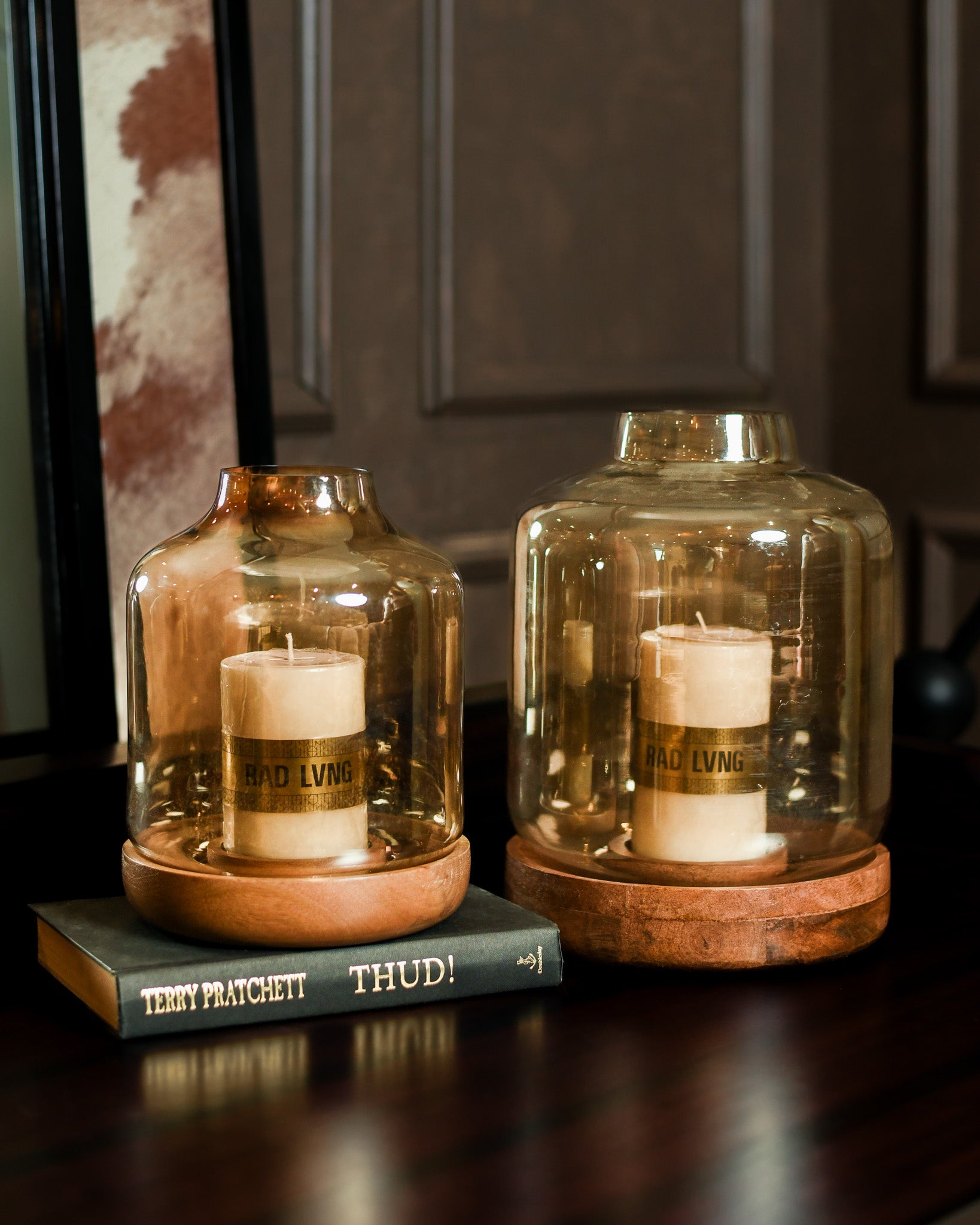
- Living room: the candle. This is your hosting space, the room you are in when the scent matters most. A candle gives you control: light it before guests arrive, let it run through the evening, blow it out when you are done. RAD LVNG candles are natural soy with roughly 1.5 times the fragrance load of the general market, and they burn up to 17, 35, or 45 hours across the 100g, 220g, and 350g sizes. Size the candle to the room and you have your anchor.
- Entryway and bathroom: the reed diffuser. These are the spaces that need to smell intentional without you doing anything. A reed diffuser runs continuously for 30 to 45 days, no flame, no supervision. The entryway sets the first impression the moment the door opens. The bathroom is the room guests judge silently. One bottle in each, same collection, and the home greets people before you do. You can see the full range in our reed diffuser collection.
- The evening reset: mood sticks. When the day has left the air feeling stale, a mood stick is one 60-minute burn that resets the whole space. Bamboo-free and charcoal-free, with much less smoke than ordinary incense, on a considered metal stand rather than a temple accessory. Light one, and the scent stays for hours after the stick is done.
- Wardrobe and drawers: the fragrance tablet. A 90 to 100 gram whole bar tucked into a wardrobe or drawer scents your clothes from the inside, so the collection follows you out the door. Tablets last 30 to 45 days, often well beyond. This is the layer most people forget, and the one that makes the scent feel genuinely yours.
The principle underneath all of it: the scent is the constant, the format is the variable. You are not matching products to each other. You are matching one collection to the way each room actually lives. We break the four-layer logic down further in our guide on how to layer home fragrance, but the headline is simple. Choose once. Place everywhere.
Why is a signature scent so hard with most brands?
A signature home scent is hard with most brands because most brands are built single-format and ingredient-named. They make candles, or they make diffusers, but rarely the same fragrance across both. And they name by note, so you are buying "Sandalwood" or "French Vanilla," not a world you can carry. The structure of the brand fights the thing you are trying to do.
Think about what happens when you try. You find a candle you love, in a scent called something generic. You want that same scent as a diffuser for the hallway. It does not exist, because the brand made the candle and a completely different range of diffusers. So you settle for a diffuser that is roughly in the same family, and now your hallway and your living room are cousins, not twins. Multiply that across four rooms and four formats and you are back to a home that smells like a collection of near-misses.
Ingredient names make it worse. When a scent is just "Lavender," there is nothing to be loyal to. Lavender from one brand is not lavender from another, and neither is yours in any meaningful way. There is no character to commit to, only a note that a hundred other products also carry.
This is the structural reason RAD LVNG works for a signature scent and most brands do not. Every one of our 12 collections is built to run across candle, reed diffuser, mood stick, and fragrance tablet, in the same blend, under the same name. So when you choose Room No. 11, you can have it as the candle in the living room and the diffuser at the door and the mood stick for the evening, and it is genuinely the same scent each time. The collection is the unit, not the product. That is what makes one home, one scent, possible to actually do rather than merely admire.
How do I control strength so one scent does not overwhelm?
You control strength through three levers: how many reeds you use, how you size the candle to the room, and where you place each product. A signature scent should be present, not aggressive. The goal is a home that smells like itself the moment you walk in, not one that announces itself before you have taken your coat off.
Reeds are your main dial on a diffuser. RAD LVNG reed diffusers come with five reeds per pack and run roughly twice the concentration of the standard market, so they have real reach. Use three to four reeds in a small to mid-sized room, all five in a mid to large room, and remove a reed or two if the scent feels too strong. They are formulated to release slowly and steadily, which is also why people sometimes pull sticks out: the issue is rarely too little, it is occasionally too much. If yours feels faint instead, that is usually placement, and we cover the fixes in why can't I smell my reed diffuser.
Candle size is your second lever. Match the burn to the room. The 100g size suits a small bedroom or bathroom, the 220g a standard living room, the 350g an open-plan or larger space. Putting a small candle in a big room leaves it working too hard, and a large candle in a small room can tip from atmosphere into too much. Size for the space and the scent sits exactly where you want it.
Placement is the quiet third lever. Keep the strongest products away from where people sit for long stretches. A diffuser belongs at an airflow point near a doorway, not on the dinner table. Mood sticks are a timed event, not an all-day presence: one 60-minute burn resets the room and then fades over the following hours. And tablets are for enclosed spaces only, wardrobes and drawers, where the scent concentrates by design and never crowds a room someone is living in.
Done right, the layers never compete. Each one is the same scent at a different volume, and the home reads as one calibrated identity rather than four things shouting the same word.
Should my signature scent change with the seasons?
A signature scent works best as a year-round identity with the option of a deliberate seasonal switch, not a constant rotation. Pick one collection as your home's default for the year, the scent you want to be known for. Then, if you want, change it intentionally for a festive stretch or a season, and switch back. The identity holds; the variation is a choice, not a drift.
The reason to hold a year-round signature is the same reason to have one at all: consistency is what makes a scent yours. If you change collections every few weeks, you never build the association. Nobody can say your home smells like anything in particular, because it has smelled like six things this quarter. Choose your default and let it become the air people expect when they walk in.
That said, India runs on occasions, and a festive switch is a real pleasure rather than a betrayal of the system. For Diwali or a winter gathering, a deliberate move to something warmer and woodier, a Room No. 11 sort of scent, makes the season feel marked. For the hot months, a fresh or citrus direction can carry the whole home lighter. The trick is to switch the whole home together, not one room at a time, so coherence survives the change. Move every format to the seasonal collection, run it for the stretch, then return to your signature. One home, one scent, with a few intentional chapters across the year.
How do I test-drive a collection before committing the whole home?
Test-drive a collection by living with the smallest format in your most-used room before you scale it across the house. Buy one product, a small candle or a single reed diffuser, place it where you spend the most time, and give it a week. A scent reveals itself over days, not in the first sniff. What charms you in a shop can tire you by day four, and what seems quiet at first can become the thing you cannot imagine the room without.
Here is the sensible sequence:
- Start with one format in one room. A 100g candle or a single reed diffuser is the lowest-commitment way in. Put it in the living room or wherever you actually live, not a spare room you rarely enter.
- Live with it for a week. Notice how it behaves at different times of day, with the windows open and closed, when you walk back in after being out. The walking-back-in test is the honest one.
- Check it against your direction. Does it still feel like you on day five, or were you reacting to novelty? A signature scent has to survive familiarity.
- Then scale to the rest. Once a collection has earned the room, carry it outward: the diffuser to the entryway, mood sticks for the evening, a tablet in the wardrobe.
The shortcut for people who already know their direction is a paired starter. Our candle and reed diffuser set gives you the two anchor formats of a single collection together, so you can test the candle in the living room and the diffuser at the door in the same week and see how the scent behaves across two formats before committing the whole home. If it holds across both, it will hold across all of them. That is your signature, confirmed, and the rest of the house is just placement.
FAQ
What is a signature home fragrance? A signature home fragrance is one recognisable scent identity carried across your entire home in different formats, the way a hotel smells like itself everywhere. Instead of a different scent in each room, you choose one collection and express it as a candle, a reed diffuser, mood sticks, and a tablet, so the whole home reads as a single coherent world.
How do I make my home have a signature scent? Choose one fragrance collection you are genuinely drawn to, then place it in every format your home needs: a candle in the living room, a reed diffuser at the entryway and bathroom, mood sticks for the evening reset, and a fragrance tablet in the wardrobe. The scent stays constant while the format changes room to room. That consistency is what creates a signature.
Will one scent everywhere feel overwhelming? Not if you control strength. Use three to four reeds in small rooms and all five in larger ones, removing a reed if it feels strong. Size candles to the room: 100g for small spaces, 350g for open-plan. Keep the strongest products away from where people sit. Each layer is the same scent at a different volume, never a clash.
Should my home's signature scent change with the seasons? Keep one collection as your year-round identity, then switch deliberately for a festive stretch if you want. Constant rotation stops a scent from ever becoming yours. A marked seasonal change, warmer and woodier for Diwali, fresher for summer, works as long as you move the whole home together and return to your signature afterwards.
Where can I find a collection that works across every format? RAD LVNG runs 12 fragrance collections, and each one spans candle, reed diffuser, mood stick, and fragrance tablet in the same scent world. Browse the full home fragrance collection to find your direction, then carry that one collection across every room in the formats your home actually needs.